
Baffled
Keir Starmer has proved too much of an enigma for me. I give up

I used to think I knew a fair bit about politics.
And why shouldn’t I? I joined the Labour Party at the age of 20, in 1984, and became immediately embroiled in its activities. I canvassed, leafleted, debated, read books about about Labour history, scoured the newspapers for anything political. I became a journalist because of my love of politics and then went on to work for the Labour Party, mixing with such luminaries as Donald Dewar, Tony Blair, Gordon Brown and John Smith. Eventually I became an MP, spending 14 years in the Commons before being chucked out in 2015.
But my education didn’t stop there. I quickly started writing on a daily basis for the Telegraph Online, charting Labour’s travails under Jeremy Corbyn and then Keir Starmer. That is still my main job. I’m paid to understand what is going on in politics, particularly in Labour politics.
And after the last few days, I have to admit something: I know nothing about politics. I give up. Starmer has defeated me, the wily old fox! He’s run rings around me. I used to pride myself on perceiving motives and strategies that were hidden from the eyes of less experienced observers. But no longer. Keir Starmer is a law unto himself. It’s not just that he doesn’t play by the rules: he doesn’t even acknowledge that such rules even exist. Perhaps he doesn’t know of them. If he does, he doesn’t care.
Consider events since Friday, when it emerged that the more pessimistic predictions of Labour losses in England’s local elections were also the most accurate. The party lost 1500 councillors in a single day. That’s an existential crisis in terms of scale. Naturally, there is great unhappiness in Labour’s ranks. Well, of course there is: even before polling day there was a growing recognition among Labour MPs that Starmer was out of his depth, a man with no political instinct whose only ambition, it appeared, was to remain in Number 10 for as long as possible. He was the “accidental prime minister”, the man who only became Labour leader because he wasn’t Jeremy Corbyn and only became prime minister because he wasn’t Rishi Sunak.
Last Thursday marked the point in the calendar when, I assumed, it would all come crashing down for Starmer. In fact, I still think that. He’s doomed; it’s just a matter of time now.
But Starmer genuinely seems not to believe that. Consider his actions since Friday. On Saturday, having surveyed the battlefield and the dead political corpses of Labour council leaders strewn lifeless in the mud, the victims (mostly) of Reform UK artillery, he unveiled his latest initiative that would allow him to bounce back from the edge of disaster. He told a stunned world that he was appointing former Labour prime minister Gordon Brown as an envoy on global financial co-operation (whatever that means) and he was also appointing Harriet Harman as an adviser on the rights of women and girls.
Wait, what?
Can someone please explain to me the thought process of a prime minister who faces the biggest crisis of his career genuinely believing that Gordon Brown and Harriet Harman are part of the solution? Was it perhaps reported back to Downing Street from the doorsteps of Hartlepool and Wigan that voter discontent either had its roots in the absence of the 2007-2010 leadership team from Downing Street, or could at least be be ameliorated by their return to frontline politics?
How many disgruntled Labour voters reluctantly embraced the Reform cause while mumbling sullenly under his breath that if only Gordon and Harriet could be brought back, they would be only too happy to continue voting Labour?
Reform’s USP is antipathy to multiculturalism and to the high levels of immigration that made it inevitable. Gordon, meanwhile, is the man who famously defined the 2010 general election – and guaranteed his party’s defeat – by referring to a northern woman as a bigot because she opposed high levels of immigration. And Keir Starmer believes Gordon is the right man to bring back right now, when Reform is breathing down Labour’s necks.
It might also be mentioned at this point that since leaving office, Brown has become something of a folk hero among Labour members and activists. But he is also a painful reminder to Starmer – or should be – of what happens to a political party when an unpopular prime minister (and Gordon really was unpopular during almost all of his tenure at Number 10) refuses to take the hint and make way for a more electable successor.
Similarly, Harriet’s reappearance on the political scene is oddly timed. The government has come under some pressure – not nearly enough, in my humble opinion – for its relaxed approach to publishing the code of practice produced by the Equality and Human Rights Commission (EHRC) on single-sex spaces. These are the guidelines that campaigners hope will clarify the Equality Act 2010, as interpreted by the Supreme Court last year, namely that “sex” in the legislation refers only to biological sex, not assumed or self-identified gender. In other words, the code of practice spells bad news for men who identify as women and who have been under the illusion for 16 years that the Equality Act gave them the legal right to use women’s facilities such as toilets, changing rooms, women’s refuges and rape crisis centres.
True, the government “welcomed” the Supreme Court’s ruling, if only through gritted teeth. The women and equalities minister, Bridget Phillipson, only recently confirmed that despite the absurd delay in publishing the guidelines, they will finally be laid before parliament soon after last week’s local elections. Women’s groups and those who genuinely care about women’s and girls’ safety have welcomed this news. Trans groups and men’s rights organisations? Not so much. But the law is not on their side.
So back to Harriet. She is on the record as saying:
Women are women who are either born women or who have transitioned to be women. There are all different sorts of women, including biological women and trans women. If you allow somebody to transition, I go with the flow of that and say ‘I’m not going to call you a man anymore, you’ve transitioned to being a woman.’
Such luxury beliefs are acceptable in certain north London, Labour lawyerly circles, where the fight for equal pay is more about whether certain female Guardian columnists are paid more than their male colleagues, rather than whether you’re paying your Estonian cleaner minimum wage or not.
A government that is clearly uncomfortable with the Supreme Court ruling that women’s rights to privacy and safety matter more than men’s entitlement to occupy their spaces is already viewed with deep suspicion by women’s rights campaigners. It is the reason why many of them could not bring themselves to vote Labour last Thursday. And now along comes Harriet with her “inclusive” word salad that really boils down to supporting the removal of women as a sex class because some men would find that convenient.
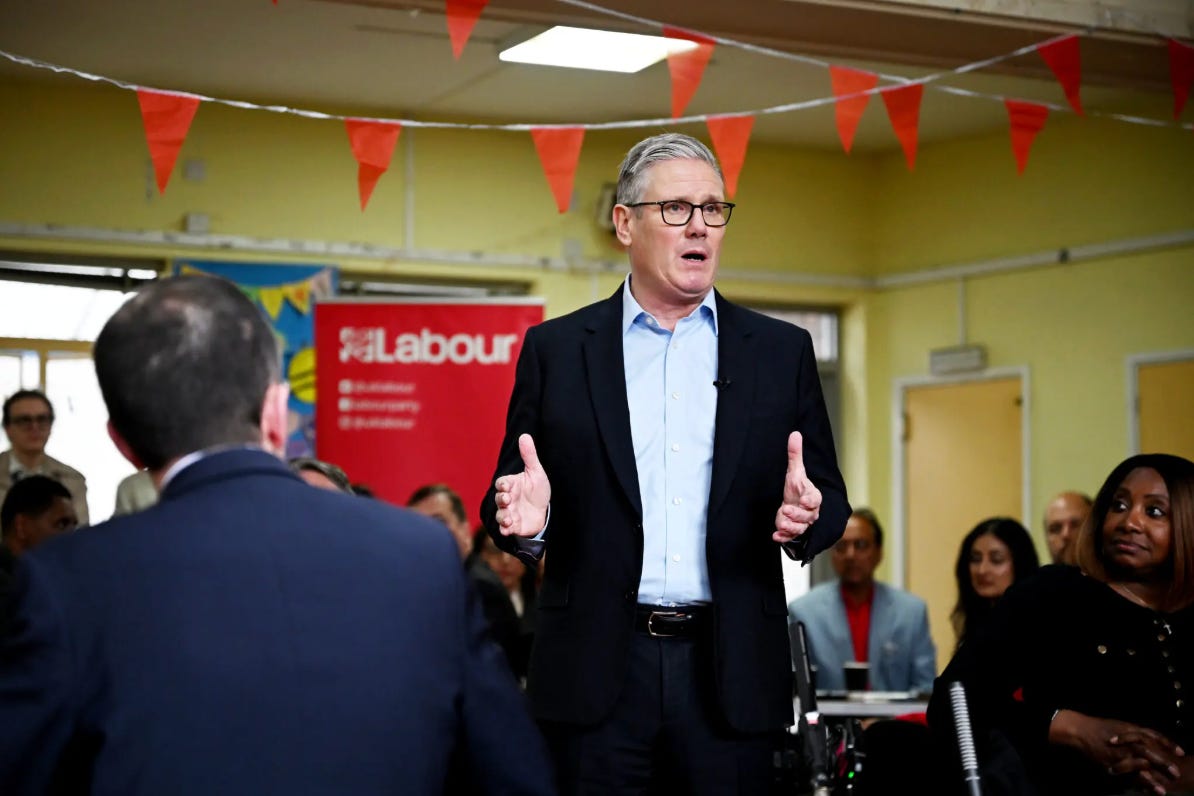
And so on to today’s latest fightback speech from Starmer, his latest “reset”, number 44 in an endless series. The centrepiece of the speech, which he delivered tieless with his sleeves rolled up because that’s the way the cool kids who sit and smoke at the back of the bus dress (and by the way, the last politician that look worked for was Juan Peron: make of that what you will), were three seismic policy changes that would remind the country that they need not regret voting for him and his party in July 2024.
The first promise: steel nationalisation. Fine, but I thought that had been done ages ago.
The second one: an EU youth mobility scheme. Oddly, Starmer didn’t describe this as a U-turn, but it certainly is. He and his ministers fiercely resisted EU pressure, in the early months of this administration, to adopt it. And now they have, and all those lovely Tarquins and Bens and Poppys can go and spend their gap yahs abroad without having to apply for visas. This initiative was part of the bigger announcement to put Britain back at the heart of the EU (but not full members, either of the EU itself or of the single market or customs union, so no change whatever, then).
But in what way is this an answer to anything? Specifically, in what way will this random assortment of warm, pro-EU words help prevent even more Labour votes being siphoned off to Reform?
The third policy was pretty baffling. Turning to his favourite bogeyman, the “far-Right”, a term that can include pretty much anyone these days, Starmer announced he was going to stop far-Right agitators from getting into the country to attend a rally in London next week. Well, fine. But shouldn’t Keir have sought to address the small problem of the rise in hate crimes against Britain’s Jews and the role played in that increase by the pro-Hamas hate marches that we have had to endure almost every week for the last two years? What about the hateful demands to “Globalise the Intifada”? What about all those Islamist hate preachers who spread vile misogynist, homophobic and anti-Semitic hatred in the name of their prophet? Many of them have no legal right to be in the country, many more arrive on our shores every week. Exactly how much more globalisation of the intifada will be necessary before Starmer fulfils his previous pledge to do “everything necessary” to combat anti-Semitism and anti-Jew violence?
Now, to the point of this column (did I hear a “Thank God!” at the back?).
The appointments of Gordon and Harriet to high-profile posts in the government, the announcement of these three policies that are either pedestrian and pre-announced, utterly baffling or profoundly misdirected – when these were discussed in Downing Street, someone, perhaps Starmer himself but there must have been others, said “Cool”. Or words to that effect. Grown up people, adults with serious, responsible jobs for which they are well rewarded from the public purse, people with degrees from the best universities, read those policies, pored over Gordon’s and Harriet’s appointments – and did so, remember, in the context of last week’s gubbing in the local, Scottish and Welsh elections – and said, “Yes, that’s fine. That’ll do it.”
And yet those people still have jobs. No one has yet chased them out of Downing Street with a big stick and a pack of dobermans. It’s truly astonishing, isn’t it? The most important speech in the prime minister’s career, the one that everyone knew would either make or break him, contained nothing of substance or importance, no mea culpa, no humility; just another series of Starmer clichés – “Labour values”, “a war that isn’t in our interests”, “dangerous times” – and some policy ideas that were, at best, interesting and, at worst, perplexing.
It should have been clear to any adviser worth the money that this was not going to cut it. But obviously no one told the prime minister. No one took him aside to say, “Look, prime minister, I know this is the best we’ve got, but it’s complete shit. I wouldn’t bother, to be honest.”
Even more Labour MPs have written open letters to Starmer since his press conference, politely expressing their hope that he will walk away with some dignity, while he still has some left. Two ministerial aides quit this afternoon. His gambit didn’t work. It didn’t deserve to.
But he’s still there as I write. And so I come to the conclusion I stated before: I know nothing about politics. The dead brainy types who work in Number 10, they’re the ones who obviously know more than I do, but it’s like we speak different languages. I can normally understand why a politician does something, even if I disagree with it. Starmer is a different kettle of fish. I will never understand him. Perhaps that is his genius. Perhaps he’s secretly running rings around all of us.
You never know.*
*We do know
I get Tarquin and Poppy, but since when was "Ben" a posh name??